

12 Nov Fabulation

In 2008, professor of English and comparative literature Saidiya Hartman asked the question, “How does one tell impossible stories?”—those that have been forgotten, mis-recorded, or lost. Much like this exhibition, she recognized that every narrative has countless other versions that have not been told. She pointedly identified archival documentation in and of itself as a system of power that records and preserves, or omits and forgets (as we see here with the failure to record artists’ names and other details).
To counter such losses, Hartman coined the methodology of “critical fabulation”—a writing approach that draws upon academic research as well as creative fiction to come up with new histories. Critical fabulation can serve as a new way of understanding museum objects with limited recorded information. For this exhibition, emerging scholar ALANA JOY OKONKWO crafted narratives drawn from collections research to fabulate histories from the perspective of three objects on view. Critical fabulation provides an opportunity for thinking through how the objects themselves may have viewed their many experiences, from creation and use, to a period of changing hands, to the eventual
lethargy of life in a museum. Okonkwo encourages visitors to acknowledge the historical and archival losses while imagining all the vibrant pasts that could have been.
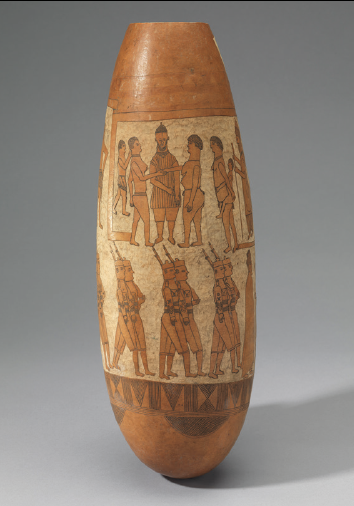
WEMBLEY GOURD; X65.5232
Life Story of a Gourd
My father was a carver; my mother was a calabash vine. They told me I was Nigerian, but a hundred years later, I’m still unsure what that truly means.
I imagine Nigeria as the pavilion where I was born, at the British Empire Exhibition.
I imagine there would be ballerinas on the streets, chiefs draped in British flags, and colonial soldiers marching with pride—these are the memories etched into my skin.
But in museum storage, I met alusi, àdá Ògún, gęlędę masks, and others. They whispered different truths to me: that they are more Nigerian than I because they have experienced the feeling of their body being decorated with patina through decades of ceremonial sacrifice; they listened to songs and chants from community members in their native tongue; and witnessed the warmth of their auntie’s smile. They offered me new perspectives of what it means to be Nigerian.
Now, as I sit in this vitrine, I am still asking: to whose version of Nigeria do I belong?
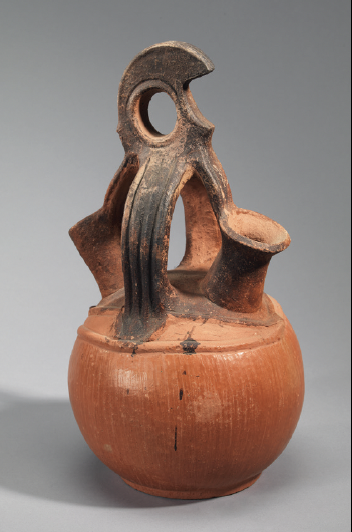
CERAMIC JAR; X65.7990
Abstract
I am captivated by the idea of Mama.
In my dreams, I imagine her touch lingering on my sunbaked skin as grooved brush strokes. She’s an artist. She paints my body like a canvas, covering my lips, neck, and shoulders with melanated beauty marks and freckles. Her wise hands sculpt me from the Motherland, turning me into a conglomeration of heritage, thumbprints and kisses, silken red clay, hums and hymns, laughter, tears and river water, and ancestral knowledge.
In my dreams, I imagine what Mama might look like, sound like, and feel like because I have lost her over time. I imagine her to be young and old, strong-willed and resilient, creative and kind.
Though our distance grows, Mama visits me in my dreams, where she cradles me in her arms in the refuge of our Motherland. I am captivated by the abstraction of Mama.
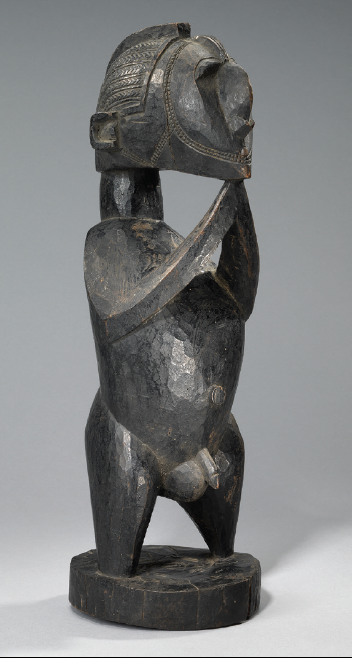
BAGA FIGURE; X65.5379
Surrealist
A French poet calls me primitive, an auction catalog calls me a statuette, a museum calls me a figure. The further away I drift from home, the more often I am perceived as bizarre, foreign, and anonymous.
Distance and time have caused me to forget precious fragments of my life story, like who was my creator and why I left them. But the same features of my body that people describe as surreal are my compass guiding me to clarity.
My hooked nose that demands attention, my smile that brings to life every corner of my face, my hair made into geometric braids along the crown of my head, and my smooth limbs that support the weight of my body—these are all qualities that make me familiar to my family back home.
Although I continue to forget my life story as time and distance separate me from my family, I am grounded by the reminder that I am an extension of my motherland.
Sorry, the comment form is closed at this time.