

13 Nov Material Studies and Conservation Science

In museums, conservators study and preserve cultural heritage items. They address instabilities (breaks, tears, flaking, etc.) and undertake preventative measures to ensure objects’ longevity (through pest mitigation, structural supports, safe storage, and climate controls). This work is informed by their knowledge of the objects’ construction techniques and material properties.
Conservators use imaging and scientific testing to learn more about the exact materials, age, structure, and use of museum items. Some of the tests are invasive (requiring a very small sample) others are noninvasive (with no samples). The results can provide important information, such as a place
of creation, and inform protocols for care and display.
Throughout this section, MARCI JEFCOAT BURTON, former Fowler fellow and conservation scientist, discusses the following techniques:
• Portable X-ray fluorescence (pXRF)
• X-ray diffraction (XRD)
• Pyrolysis gas chromatography mass spectroscopy
(TD-Py-GC/MS)
• Polarized light microscopy (PLM)
• X-radiography (X-Ray

EMORIAL SCULPTURE; X65.9130
Analyzing Metals
This work is made from cast copper alloy—a broad term indicating that a metal is primarily copper, mixed with another metal. Copper alloys include brass (copper with zinc), bronze (copper with tin), gunmetal (copper, tin, and zinc), etc. The yellow-gold coloration is characteristic of brass and was confirmed as such with portable X-ray fluorescence (pXRF), a non-invasive material analysis technique that detects metallic elements using fluorescent x-rays.
A dark brown patina is present overall as a result of the natural process of surface oxidation from exposure to the environment over a long time. The top of the head has a circular pattern of shiny, less patinated metal, and indicates that a component once resided in this location but is now lost. White corrosion borders the circular shape, which also contains patches of green corrosion. Micro-samples (less than a pencil tip) of each corrosion product could be analyzed with X-ray diffraction (XRD), a helpful form of analysis that identifies crystalline materials, such as metal corrosion compounds.
Their identification could suggest what was fastened to the top of the head.
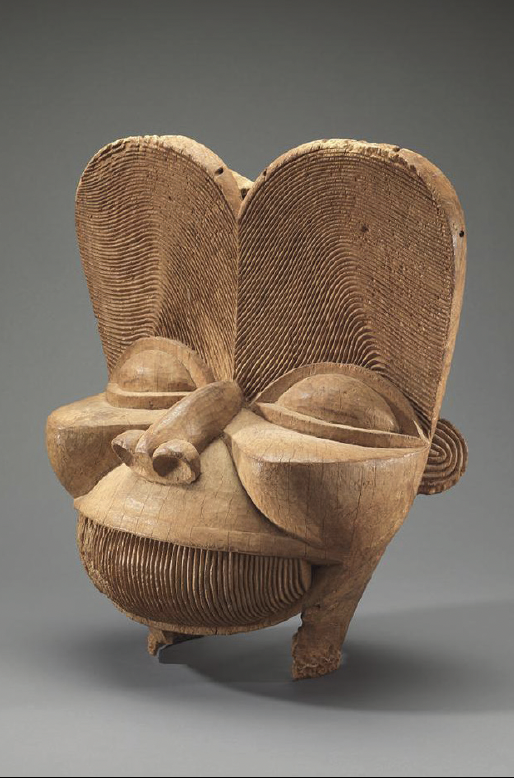
TSESAH (MASK); X65.5820
Characteristics of Wood
Carved wooden objects are susceptible to condition changes due to temperature and humidity. Higher levels of humidity cause the wood to expand as it absorbs water vapor from the air. Lower levels of humidity cause the wood to lose water held within its structure, causing shrinkage. Both scenarios create structural change, leading to cracking as a way for the wood to relieve strain and pressure. A network of small, shallow cracks on the surface of this mask can be attributed to the object’s lifetime of exposure to fluctuating temperature and humidity.
The type of wood used to carve the mask could be identified through thermal desorption pyrolysis gas chromatography mass spectroscopy (TD-Py-GC/MS). This technique analyzes the chemical extractives from a micro sample (less than a pencil tip) of wood collected from the object and matches it to known wood standards to make a tree species identification. Such knowledge can aid conservators and curators by indicating possible condition susceptibilities, as well as support provenance data by linking a tree species to the purported place of the object’s creation
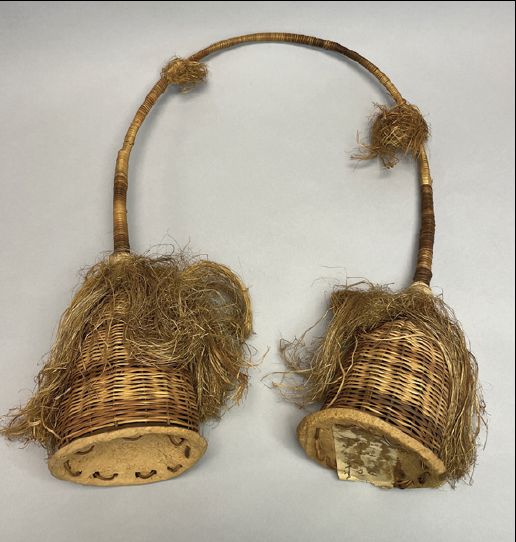
RATTLE; X65.8251
Plant Fibers and Physical Structure
This rattle is constructed entirely from plant materials, most of which can be visually identified with polarized light microscopy (PLM). Such analysis requires a very small sample of each material: a single fiber from a tassel, and small cross-sections (less than 1 mm thick) of the basket rattles and handle elements. Physical structures and luminescence characteristics of each material are observed under the microscope and compared to known reference microscopy images of plants from the region to aid in the identification process. This knowledge can also assist in collection care protocols.
One issue with hollow, enclosed objects, such as the rattles, is the inability to see inside them. X-radiography is a helpful diagnostic tool for complex and layered objects and enables visualization of the interior components without the need to deconstruct an object. While X-radiography is physically non-invasive, its effect on an object’s intangible aspects (spiritual, ritualistic, etc.) has been recently called into question: can it be truly considered “non-invasive”? This matter raises awareness of the importance of establishing connections with the communities-of-origin representatives whose knowledge and experience can inform what is deemed ethically appropriate in testing an object.

Sorry, the comment form is closed at this time.